Protected: The check-in campaign – Apffelstaedt, Hoosain & Associates
ABOUT THE PROJECT
About the project
It is easy to put your own health last when work, family and everyday responsibilities compete for attention. For World Cancer Day 2026, Apffelstaedt, Hoosain & Associates’ Check-In Campaign encouraged younger adults to pause, notice changes in their bodies and seek advice when something felt different.
Aligned with the global theme “United by Unique”, the campaign focused on individual risk and the particular challenges of a cancer diagnosis before 50, from parenting and fertility to careers and financial pressures.
With accessible information on breast, thyroid, parathyroid and colorectal health, alongside a practical checklist in English, Afrikaans, isiXhosa and isiZulu, the campaign gave audiences a starting point for informed conversations about their health.
BRIEF AND REQUIREMENTS
Brief
Develop Apffelstaedt, Hoosain & Associates’ annual World Cancer Day campaign for 2026. We chose to focus on younger adults and created the Check-In Campaign around a simple invitation: give your own health some of the attention you give everyone else. Connecting with the global “United by Unique” theme, the campaign encouraged awareness of personal risk, bodily changes and when to seek professional advice.
Requirements
We set out to make World Cancer Day useful to younger adults, with clear information about personal risk and changes worth discussing with a healthcare professional. The campaign needed to connect specialist knowledge with everyday life, offer practical resources in multiple languages and bring patient experiences into the conversation. We shaped the full approach, bringing creative development, website content, social media and media relations together.
WHAT WE DID
What we did
We created the Check-In Campaign, choosing younger adults as the priority audience and developing its messaging, creative direction and channel plan around the global “United by Unique” theme.
At its centre was our idea for a practical check-in checklist: something people could use beyond an awareness-day post. We wrote the resource and coordinated translations into Afrikaans, isiXhosa and isiZulu, alongside the English version.
We gave the campaign a home online, developing the website page brief, writing the copy and working with the developer through to launch. We also briefed and managed the design, coordinated suppliers and produced social visuals using the approved templates.
Working with the practice to source patient stories, we developed questions and shaped the responses into personal accounts. Each went through clinical review and patient approval before we uploaded it, with supporting information and links to relevant website pages.
We wrote and scheduled social content, scripted and produced short videos featuring the doctors, and managed targeted paid promotion. As performance data came in, we adjusted the promotion strategy.
Mainstream and medical press releases opened different routes into the cancer conversation. We handled pitching, distribution and interview coordination, then secured permission to upload broadcast recordings and share them through social channels. Media monitoring and digital reporting tracked how the campaign travelled and which content drew audiences in.

COMMUNICATION ACTIVITIES
A practical guide in four languages
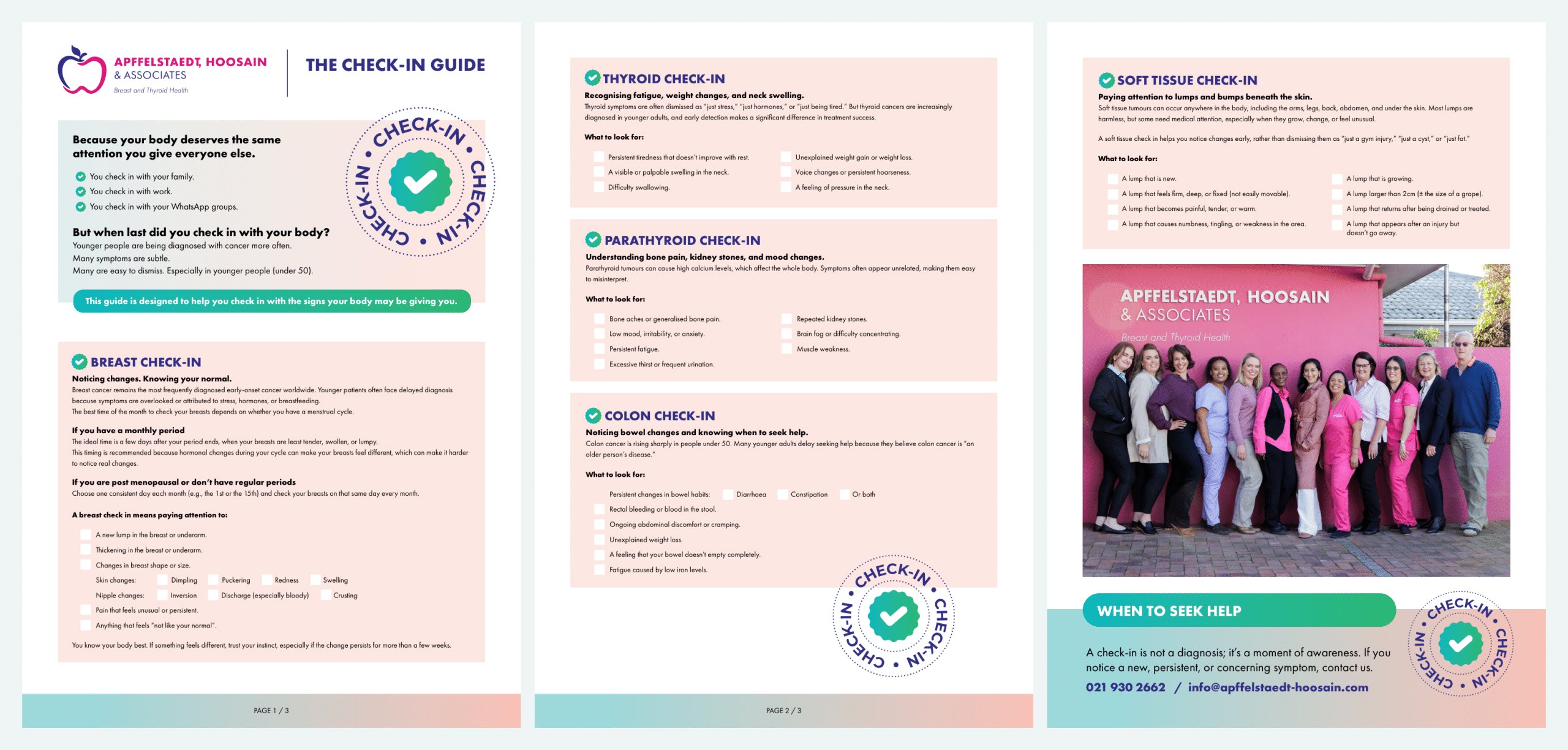
We conceived and wrote the Check-In Guide to give audiences something useful to keep, share and return to. The three-page resource brings together checklists covering breast, thyroid, parathyroid, colon and soft tissue changes, with guidance on seeking professional advice. We coordinated translations to make it available in four languages.
Explore the full guides:
OUTCOMES
The campaign secured broadcast and online coverage, bringing younger adults’ health, individual risk and early detection into wider public discussion.
Following its January launch, the campaign gathered momentum in February. Facebook views increased more than fivefold compared with January, driven largely by campaign activity. Organic reach and interactions also grew, while the dedicated campaign page became one of the website’s three most visited pages.
Activity eased in March as the main campaign push wound down, but interest continued. Patient stories attracted further clicks and website visits, while organic search traffic grew, extending engagement beyond World Cancer Day.
These headline results provide a broad overview of campaign performance. Confidential client information and detailed internal reporting have been excluded.